Recent programme reports from Italy have highlighted encouraging outcomes from Rhythm2Recovery-based programmes delivered in primary schools across the Puglia region.
Facilitated by Vincenzo Cantatore from Tamborey, the Rhythm2School programmes used rhythm, percussion and reflective discussion to support social and emotional development in primary school children.
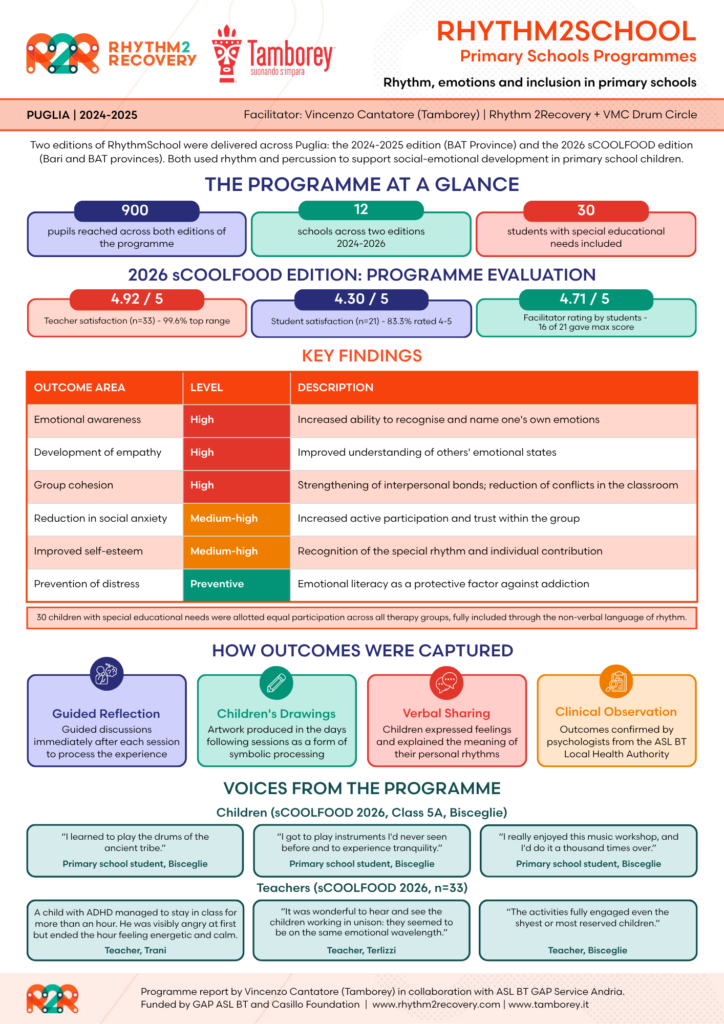
Across the 2024 to 2026 editions, the programmes reached 900 pupils across 12 schools, including 30 students with special educational needs.
Supporting emotional development through rhythm
The Rhythm2School programmes were designed to support children to better understand their emotions, strengthen empathy and build more positive connections with classmates.
The programme evaluation found high outcomes in emotional awareness, empathy and group cohesion. Children showed an increased ability to recognise and name their own emotions, understand the emotional states of others, and strengthen interpersonal bonds within the classroom.
The evaluation also identified medium-high outcomes in reducing social anxiety and improving self-esteem, with increased participation, trust and recognition of each child’s individual contribution.
Strong feedback from teachers and students
The 2026 sCOOLFOOD edition received very positive feedback from both teachers and students.
Teacher satisfaction was rated at 4.92 out of 5, with 99.6% in the top range. Student satisfaction was also strong, with 83.3% of students rating the programme 4 or 5 out of 5. Students rated the facilitator 4.71 out of 5, with 16 out of 21 students giving the maximum score.
Teachers observed that the activities helped children work together, engage more fully and connect through shared rhythm and music-making.
One teacher reflected:
“It was wonderful to hear and see the children working in unison: they seemed to be on the same emotional wavelength.”
Another noted:
“The activities fully engaged even the shyest or most reserved children.”
Inclusion through non-verbal participation
A particularly important outcome was the inclusion of students with special educational needs.
The programme report noted that 30 children with special educational needs were included across the therapy groups and given equal opportunities to participate through the non-verbal language of rhythm.
This highlights one of the key strengths of rhythm-based group work. It can create shared experiences that do not rely only on verbal communication, allowing children with different abilities, learning styles and confidence levels to take part meaningfully.
One teacher shared:
“A child with ADHD managed to stay in class for more than an hour. He was visibly angry at first but ended the hour feeling energetic and calm.”
How outcomes were captured
The programme outcomes were captured through guided reflection, children’s drawings, verbal sharing and clinical observation.
Children were encouraged to reflect immediately after each session, express their feelings, and explore the meaning of their own personal rhythms. Artwork created in the days following sessions also offered a form of symbolic processing, allowing students to represent their experience in another way.
Clinical observations by psychologists from the ASL BT Local Health Authority helped confirm the positive outcomes observed throughout the programme.
Children’s voices from the programme
Student reflections showed how memorable and enjoyable the programme was for participants.
Children described learning to play new instruments, enjoying the music workshop and wanting to repeat the experience.
One student shared:
“I got to play instruments I’d never seen before and to experience tranquillity.”
Another said:
“I really enjoyed this music workshop, and I’d do it a thousand times over.”
A growing impact in schools
The Rhythm2School outcomes add to the growing body of practice-based evidence showing how rhythm and group music-making can support children’s emotional literacy, social connection and inclusion.
These findings are especially valuable for schools seeking practical, engaging and accessible ways to support wellbeing, emotional regulation and classroom cohesion.
We are grateful to Vincenzo Cantatore and Tamborey for their ongoing work in documenting and expanding Rhythm2Recovery practice across schools in Italy.
Programme report by Vincenzo Cantatore, Tamborey, in collaboration with ASL BT GAP Service Andria. Funded by GAP ASL BT and Casillo Foundation.