Our Indigenous focused training has been developed with cultural support from ‘Yorgum Aboriginal Healing Services’ in Australia and members of the Surrey School District Aboriginal Education Department in British Columbia, Canada. As well as several individuals of Indigenous descent working with the Rhythm2Recovery Program across Australia, New Zealand, Canada, Africa and the USA.
These workshops are delivered annually across northern and central Australia in Darwin, Broome, Cairns and Alice Springs and can be delivered privately upon request.
The key focus of this modified workshop & the accompanying manual is on ensuring cultural safety, and in particular focusing on two-way learning that strengthens participants sense of cultural identity and belonging and serves to foster inter-cultural understanding and respect. The term ‘Two-Way’ represents a need for communication and knowledge to pass in two directions. Critically this helps to clarify language differences and meanings and provide explanatory bridges of understanding and awareness for both groups. This reciprocal relationship comes with responsibilities to each other informed by Aboriginal & 1st Nation’s ways of being, whereby “you give to me and I give back to you.” This involves such things as “attempting to understand each other’s worldview, exerting efforts to trust each other, and making relations stable through transparent obligations and expectations.
A key element in delivering to Indigenous groups is the traditional preference for experiential learning through participation and observation rather than dialogue. The reflective part of the Rhythm2Recovery model is based up contemporary therapeutic practice and thus closer aligned to western traditions of learning than Indigenous ones. Hence, in our Indigenous workbook the participatory music has a greater focus, where a wide range of social skills, teamwork skills and relationship skills generally, are modelled by the facilitators and developed over time by the participants as they improve their ability to make music together. The nature and quality of the music they make is a direct reflection of these skills. The same skills that are critical across the life-span in developing and nurturing the relationship needed for a healthy, productive and happy life, and to meet the many challenges life throws at us.
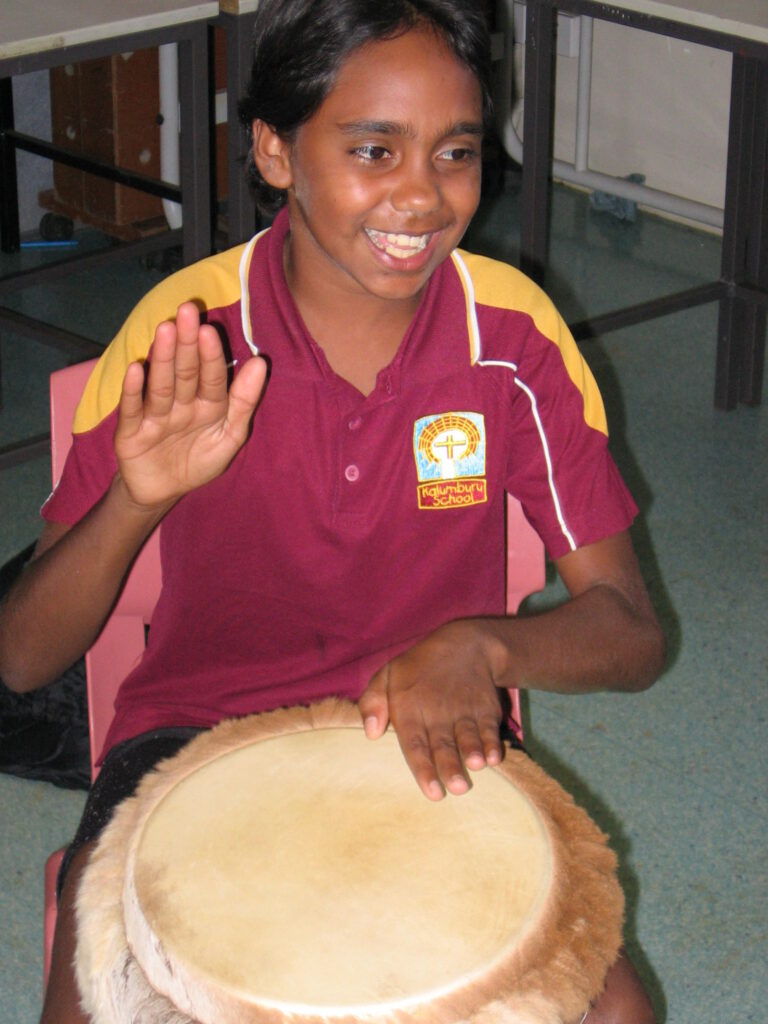
Rhythm2Recovery respects traditional drumming practices and does not trespass on cultural drumming protocols or teach cultural drumming rhythms. Our approach utilises improvised hand drumming where participants are encouraged to find their own rhythm and connect it to others in harmony. When delivered in Aboriginal and other 1st Nations communities where there is a cultural tradition of drumming, permission from elders must be obtained before proceeding with the clear clarification that the program does not utilise or teach cultural rhythms. At the same time, many rhythmic cultures are happy to share their cultural practices and where authority is given, these may be incorporated into a program by a facilitator or participant who carries that authority. Working collaboratively and openly with local elders or community leaders will ensure you do not trespass on traditional practices and boundaries.
Document on Avoiding Cultural Appropriation.
Testimonials
I felt this was the first training I have attended that everyone, across all cultures and literacy levels, could contribute equally. It was fabulous!
Alice Cazalet, Health Coordinator, Children’s Ground, NT, Australia
Over the past 12 months Rhythm2Recovery has run two workshops in Ntaria involving predominantly local Indigenous staff employed to work with children and youth. Feedback from participants in these workshops was highly favourable. Simon’s ability to use plain language and fun, practical exercises meant language differences were easily overcome. Simon also demonstrated a keen unde… Show more
Dr Annie Kennedy, Manager, Ntaria Stronger Communities for Children, Tjuwanpa Outstation Resource Centre, Via Hermannsburg, NT, Australia
I found this training empowering and encouraging, and very practical – full of great exercises for me to use in my school programs, and also useful for working with their parents.
Mavis Dumont, Aboriginal District Cultural Facilitator, Surrey School Board, Canada
Very useful experiential training. This has provided me with many useful interventions I can incorporate into my work for the social & emotional development of both the young Maori people I work with & their parents.
Nolan Hodgson, Child & Family Therapist, Raukawa Charitable Trust, New Zealand.